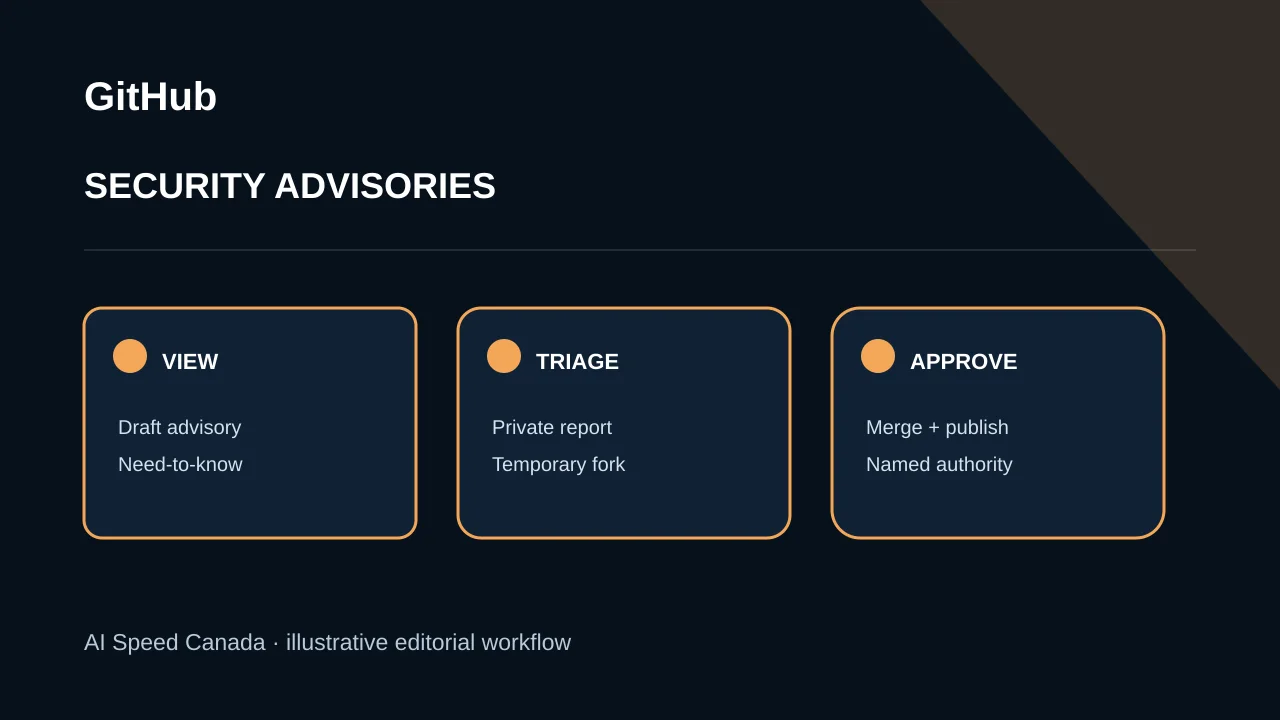
GitHub made four security-advisory permissions generally available on November 20, 2026 for organizations whose plans support custom repository roles, including GitHub Enterprise Cloud. Owners can now let a person or team work with repository security advisories and private vulnerability reports without making them repository administrators or organization-wide security managers. This is a finer authorization option, not an automatic remediation service.
Viewing, managing, accepting and publishing are distinct powers
The first permission allows viewing draft advisories, status and comments. A broader permission adds creating and editing advisories, commenting, managing collaborators and creating a temporary private fork. Separate permissions cover accepting private vulnerability reports and closing or reopening advisories, and publishing advisories or requesting CVEs.
The accept and publish permissions depend on view or manage access rather than operating alone. Organizations should build roles around real responsibilities instead of checking every box. A triage team may need to accept a report, for example, without having authority to publish an advisory publicly.
Related sources: GitHub: Security advisory permissions are generally available ↗
Some private-fork actions still require a stronger role
GitHub says merging changes from a temporary private fork still requires a repository administrator or security manager. People with the new permissions cannot delete a temporary private fork. Confidential comments require both the create-edit-manage permission and write access to the repository.
These boundaries matter in an incident runbook. A team that can prepare a fix may still need a named administrator for the merge and another approved person for public disclosure. Test the handoffs before a real vulnerability arrives, including what happens when the primary approver is unavailable.
Related sources: GitHub: Security advisory permissions are generally available ↗
Canadian organizations should map advisory data and disclosure duties
A private report can contain exploit details, affected versions and information about a reporter. Canadian organizations should limit access, define retention and ensure notification or contractual duties are assessed by the appropriate legal and security owners. A custom role can reduce unnecessary visibility, but it does not decide those obligations.
Assign the role to a test team on only the repositories it maintains, then verify each permitted and denied action with non-production content. Record who can add collaborators, request a CVE, publish, merge and close the incident. Review the mapping after team changes and remove stale assignments promptly.
Success is a controlled response, not more role assignments
Useful measures include time to acknowledge a valid report, time to create a private fix, required approval delays and whether access matched the runbook. Count unauthorized disclosure or blocked-response events separately. A smaller administrator population is helpful only if the remaining workflow can still respond safely.
GitHub's announcement establishes product availability and permission boundaries. It does not prove that an organization's custom role is correctly designed. The defensible outcome comes from a tested least-privilege role, an available approval path and a verified fix process.
Sources and editorial method
We use the linked original statements and reports to distinguish documented facts from our analysis. Company announcements describe their authors’ plans and claims; they are not independent verification of future outcomes. This article is dated and will be revised if material evidence changes. Read our editorial standards and corrections process.
- GitHub: Security advisory permissions are generally available ↗ — Official November 20, 2026 release; four permissions, dependencies, plan availability and private-fork limitations.