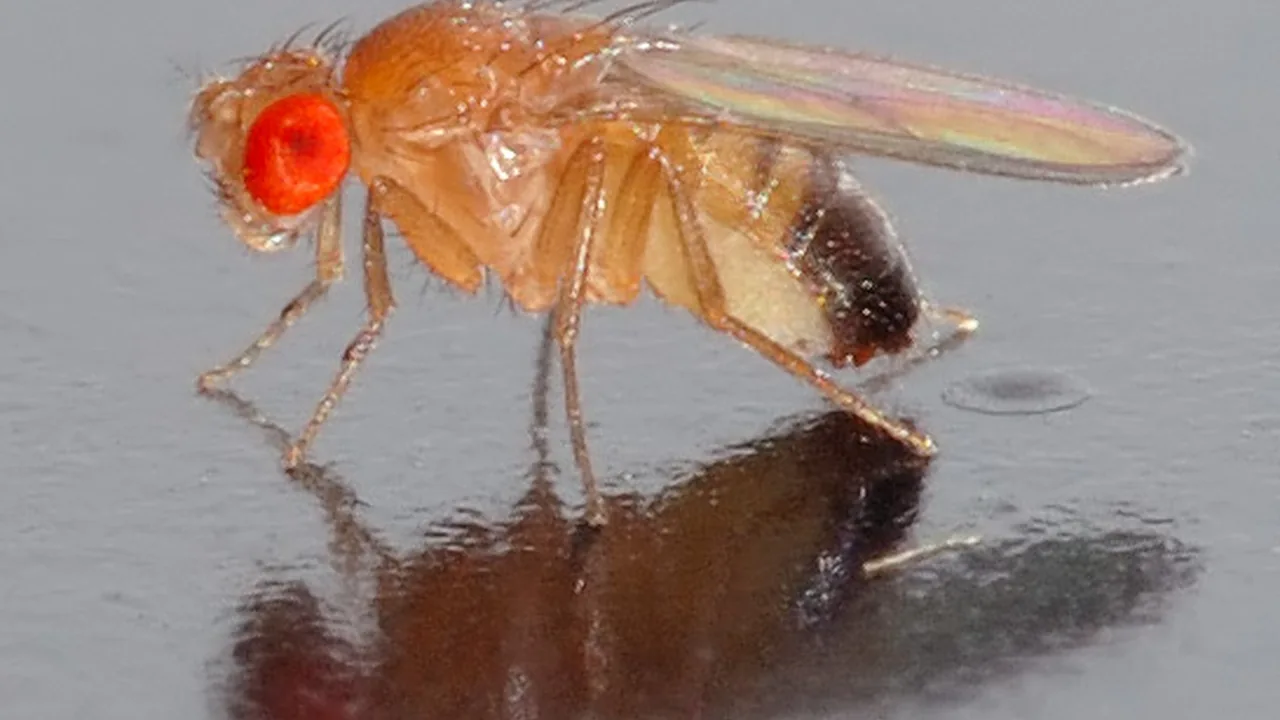
Google’s male fruit fly brain-mapping article, published September 3 and updated September 21, 2026, describes a complete map of the adult male central nervous system with more than 166,000 neurons. The work involves HHMI Janelia, Google Research, Cambridge collaborators and other researchers.
AI helps reconstruct three-dimensional neural structures from many microscopic image slices. This is a structural resource for experiments in a model organism. It is not a complete explanation of behaviour, a human brain map or evidence that a computer has reproduced the organism’s intelligence.
Reconstruction makes a large dataset usable
The team describes imaging thin sections and combining them computationally into neural shapes. Its update illustrates connections between sensory and motor systems and points readers to companion research. A visualization is an entry point; anyone drawing a scientific conclusion should inspect the associated methods, annotations and publication.
For Canadian researchers or students exploring the data, begin with one clearly defined question and the relevant part of the map. Record the resource version and how a structure was selected. A beautiful rendering can hide uncertainty if the viewer cannot tell which annotations are directly supported and which reflect an interpretation.
Related sources: Google male fruit fly mapping update ↗ · HHMI Janelia male CNS connectome project ↗
A connection map does not replace an experiment
Knowing that two cells connect can suggest a hypothesis, but the next question is how the relationship functions in a living organism under particular conditions. Design a comparison that could disprove the hypothesis rather than treating the map as a final answer. Keep anatomical observations distinct from claims about activity or behaviour.
The male and female datasets also require careful comparison of scope and annotation. A difference in a visualization may reflect the way data was selected or processed. Explain the comparison procedure before attributing a difference to biology, and preserve alternative explanations when the available evidence cannot distinguish them.
AI’s contribution should stay specific
The useful technology story is how computational reconstruction helps specialists work with a large volume of imagery. It does not mean that expert review becomes unnecessary. Ask where automated segmentation was checked, how corrections are represented and whether downstream analyses can trace a result back to the underlying material.
Our analysis is that shared maps can lower the barrier to asking reproducible research questions. Their value grows when users understand both the data and its limits. Readers should look for experimentally supported follow-up findings, while resisting the leap from an anatomical dataset to claims about consciousness, clinical treatments or fully understood brains.
Sources and editorial method
We use the linked original statements and reports to distinguish documented facts from our analysis. Company announcements describe their authors’ plans and claims; they are not independent verification of future outcomes. This article is dated and will be revised if material evidence changes. Read our editorial standards and corrections process.
- Google male fruit fly mapping update ↗ — Primary team update first published September 3, 2026, revised September 21; map scope and reconstruction method.
- HHMI Janelia male CNS connectome project ↗ — Original project resource from a research collaborator; inspect linked data and publications for study-specific methods.