OpenAI announced on November 16, 2026 that computer-use agents, updated clinical search and more than 20 healthcare plugins are available through its healthcare products. The agents can click and type across existing software for tasks such as referrals, prior authorization and document transfer. Product availability is distinct from evidence that any deployment improves patient outcomes.
Published evaluations mix model tests and customer reports
OpenAI reports that physicians rated 99% of 325 reviewed GPT-6 Astra tasks clinically safe and rated 93% of 646 assessments very or extremely helpful. On Stanford’s HealthAdminBench, it reports Astra at 94.3% of rubric points and Luna at 91.8%, with Luna costing US$0.085 per task at maximum reasoning effort.
Those figures describe specified evaluations, not an error rate for live hospitals. The MRI demonstration used synthetic patient data, while customer examples include pilots and production workflows with their own controls. Buyers should request task definitions, failure cases, reviewer agreement and local validation.
Related sources: OpenAI: Advancing computer-use agents for healthcare teams ↗
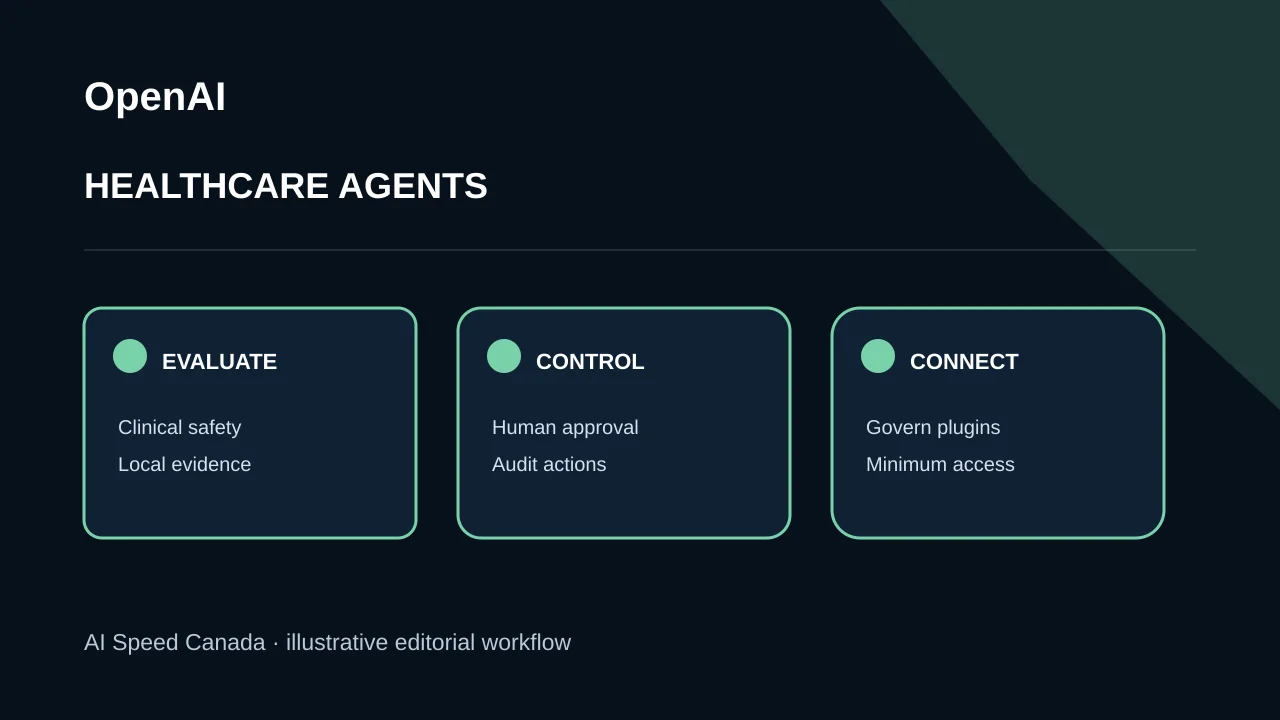
Human review, access limits and audit trails are core requirements
OpenAI describes role-based access, audit logs, configurable application access and approval steps. It says organization data is not used to train foundation models. For U.S. protected health information, the company requires eligible services under a Business Associate Agreement plus specified security and retention settings.
A Canadian organization needs its own privacy, clinical-safety, procurement and residency assessment; HIPAA language is not a Canadian compliance determination. Limit the agent to the minimum records and actions, require confirmation before orders or submissions, and test recovery from ambiguous screens and changed portals.
Related sources: OpenAI: Advancing computer-use agents for healthcare teams ↗ · OpenAI: More ways to move care forward with ChatGPT for Healthcare ↗
Plugins expand reach and compound permission boundaries
OpenAI lists more than 20 new healthcare plugins spanning records, scheduling, clinical references, eligibility and cost workflows. Each connection creates a separate identity, data, retention and failure boundary. A multi-plugin answer can be polished while joining mismatched patients, dates or benefit rules.
Start with one low-risk workflow and a documented source of truth. Measure correction time, near misses, unauthorized-action blocks and clinician workload—not just completed clicks. Keep manual paths available and never treat generated clinical text as final without accountable professional review.
Sources and editorial method
We use the linked original statements and reports to distinguish documented facts from our analysis. Company announcements describe their authors’ plans and claims; they are not independent verification of future outcomes. This article is dated and will be revised if material evidence changes. Read our editorial standards and corrections process.
- OpenAI: Advancing computer-use agents for healthcare teams ↗ — Official November 16, 2026 research and deployment post; evaluations, examples, access controls and availability.
- OpenAI: More ways to move care forward with ChatGPT for Healthcare ↗ — Official November 16, 2026 product announcement; clinical search, plugin ecosystem, availability and stated governance requirements.