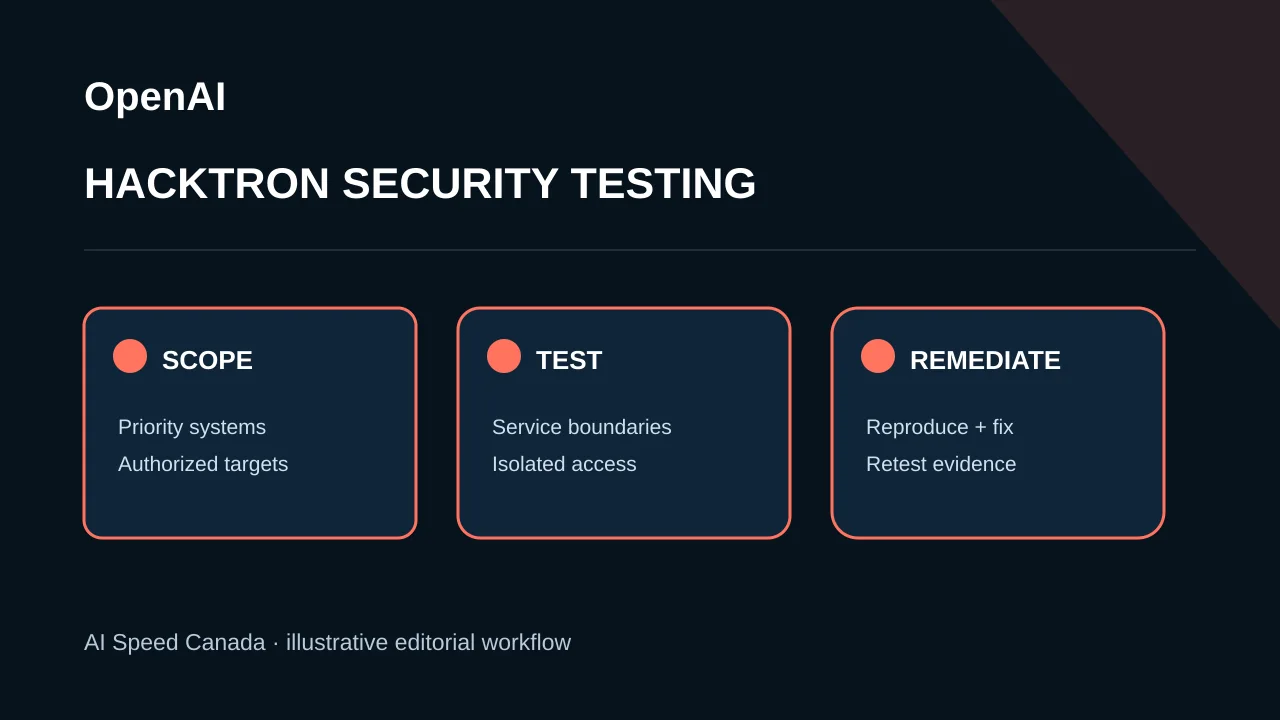
OpenAI announced a security partnership with Hacktron on November 6, 2026. The two teams will choose high-priority areas to test together, with particular attention to connections between OpenAI systems and third-party services. Hacktron will receive expanded access to frontier cybersecurity models through Daybreak Red. This is a plan for coordinated research, not evidence that a named vulnerability has been found or fixed.
The work builds on a bug-bounty relationship
OpenAI says it became familiar with Hacktron through its Security Bug Bounty program. Hacktron develops agents for code review, penetration testing and red teaming, and its researchers have previously reported vulnerabilities to OpenAI. The announcement does not enumerate those findings or provide severity, remediation-time or recurrence data.
A partnership can create deeper access than an ordinary external report, but it can also blur who evaluates success. Useful future evidence would identify scope, independently reproduced findings, accepted fixes and whether retesting confirmed that the weakness was removed.
Related sources: OpenAI: partnering with Hacktron ↗
Third-party connections are a useful but broad target
Agent systems can cross boundaries between applications, cloud services and identity systems. A flaw may arise from the interaction rather than from either component alone. Testing should cover authorization, confused-deputy risks, token handling, prompt-injection paths, audit trails and what happens when a connected service returns malicious content.
The announcement says these connections are a focus but does not claim comprehensive coverage. Allowlisted targets, isolated accounts, short-lived credentials and stop controls still need to enforce the legal scope outside the model prompt.
Related sources: OpenAI: partnering with Hacktron ↗
Daybreak Red access is not unrestricted availability
OpenAI describes Daybreak Red as a controlled route for authorized cybersecurity work. Expanding Hacktron’s access does not make frontier cyber models generally available or certify their output. Candidate findings still need reproduction, impact analysis and human-reviewed disclosure.
The most relevant comparison is not the number of generated alerts. Teams should measure unique confirmed vulnerabilities, false positives, time to verified fix and regressions after remediation. A model can accelerate discovery while also increasing review burden.
Related sources: OpenAI: partnering with Hacktron ↗
Canadian organizations should define authorization before testing
A Canadian organization using external security researchers should state which systems, tenants, data and hours are in scope; who can approve escalation; and how sensitive artifacts are retained and destroyed. Contracts and privacy obligations matter when third-party services or personal information appear in a test path.
AI Speed will treat future vulnerability and remediation reports as separate evidence. Until then, the defensible description is a coordinated testing partnership, not proof that OpenAI systems or connected services have become secure.
Sources and editorial method
We use the linked original statements and reports to distinguish documented facts from our analysis. Company announcements describe their authors’ plans and claims; they are not independent verification of future outcomes. This article is dated and will be revised if material evidence changes. Read our editorial standards and corrections process.
- OpenAI: partnering with Hacktron ↗ — Official November 6, 2026 partnership announcement; describes scope, relationship and Daybreak Red access, but no completed findings.